|
NOT IN RIC
|
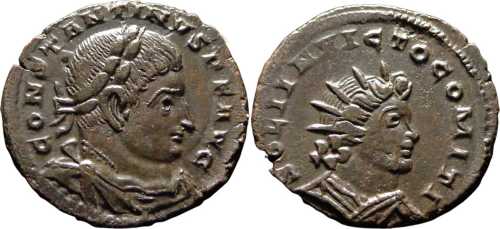
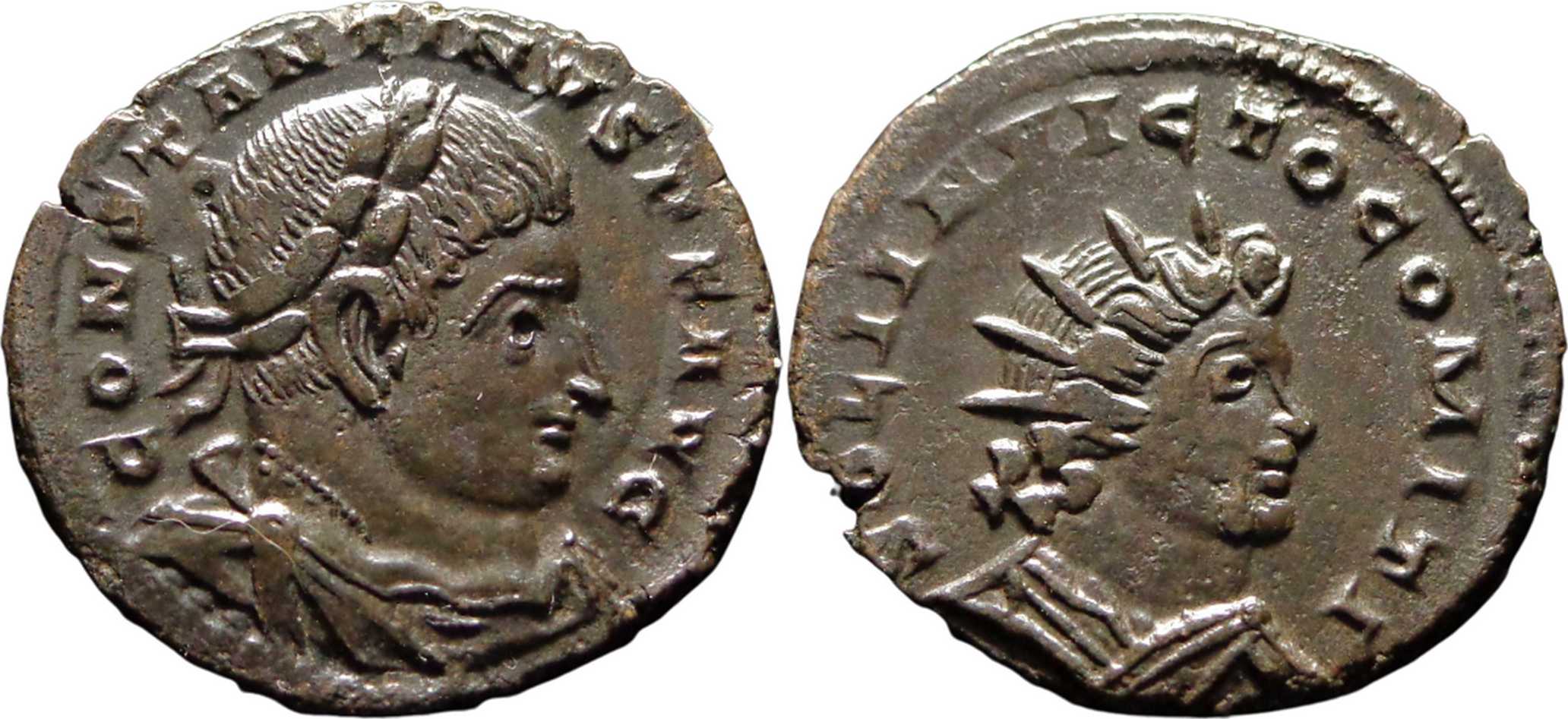
UNLISTED ISSUE. According to the preliminary study published by Genio popvli romani, not only T|F/PTR emission was continued after the 1/96 reduction [RIC VII TRIER 39-60] but also the emission of unmarked folles with bust of Sol on reverse [RIC VI TREVERI 886-895]. The main problem is to distinguish this later part from the earlier one, issued on the 1/72 standard. As Sutherland wrote in RIC VI (footnote 1 on p. 227): "It is not always easy to distinguish this earlier and heavier unmarked series from the lighter one, with the same types, which appeared after Maximinus' death: the weight-peaks are quite distinct from each other, but the light 'heavies' and the heavy 'lights' inevitably tend to overlap".
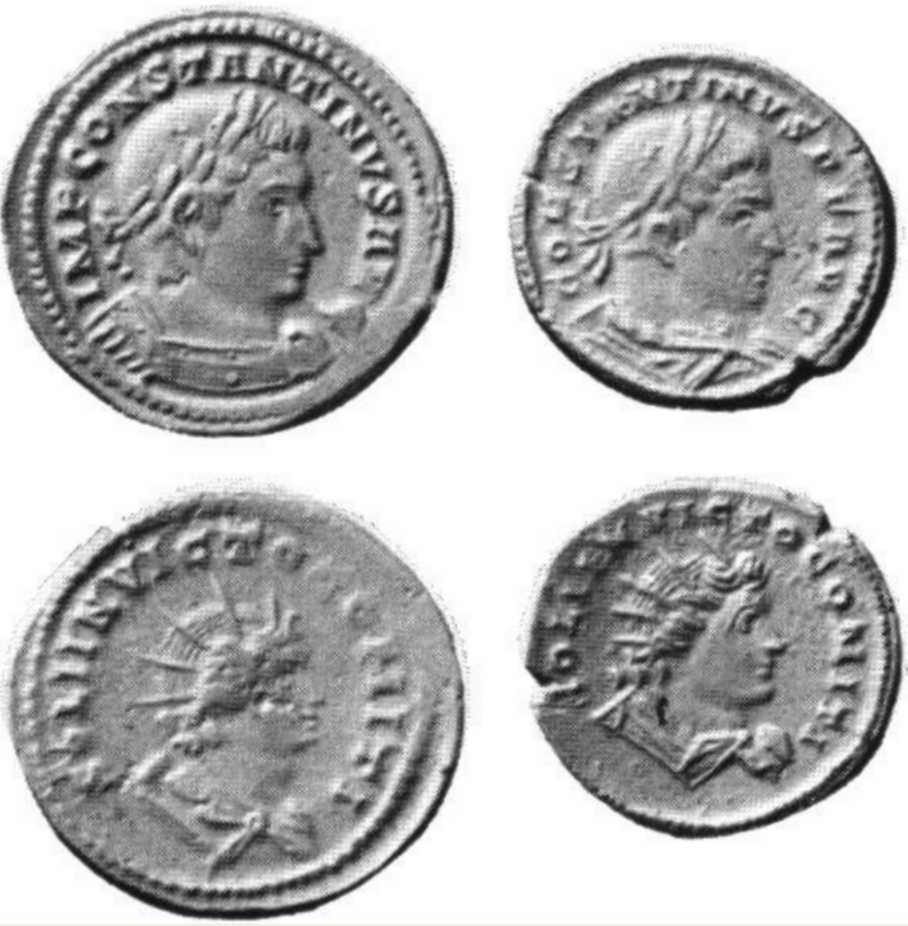
The preliminary study cited above suggests that the most crucial data is not the weight, but the diameter of die (PRD), i.e. pearl ring diameter (which should not be confused with a diameter of flan!). For earlier and heavier coins, issued on the 1/72 standard, we may assume that the diameter of beaded circle is at least 21-22 mm. For lighter coins, issued on the new 1/96 standard, this diameter is significantly smaller - c. 19-20 mm.
Compare the size of coins from both emissions. Coin on the left is from the 1/72 emission, however, quite light (weight 4.02 g). Coin on the right is from the 1/96 emission (weight 3.38 g). [Source: Huvelin, H., Brenot, C., Callu, J.P., "Trouvaille constantinienne au cabinet des médailles de Lausanne", Schweizerische numismatische Rundschau 1978, no. 57, pp. 194-195 and pictures 365, 369 on plate 56].
Keep in mind that diameters given below are usually diameters of flan, so attribution is in many cases uncertain.
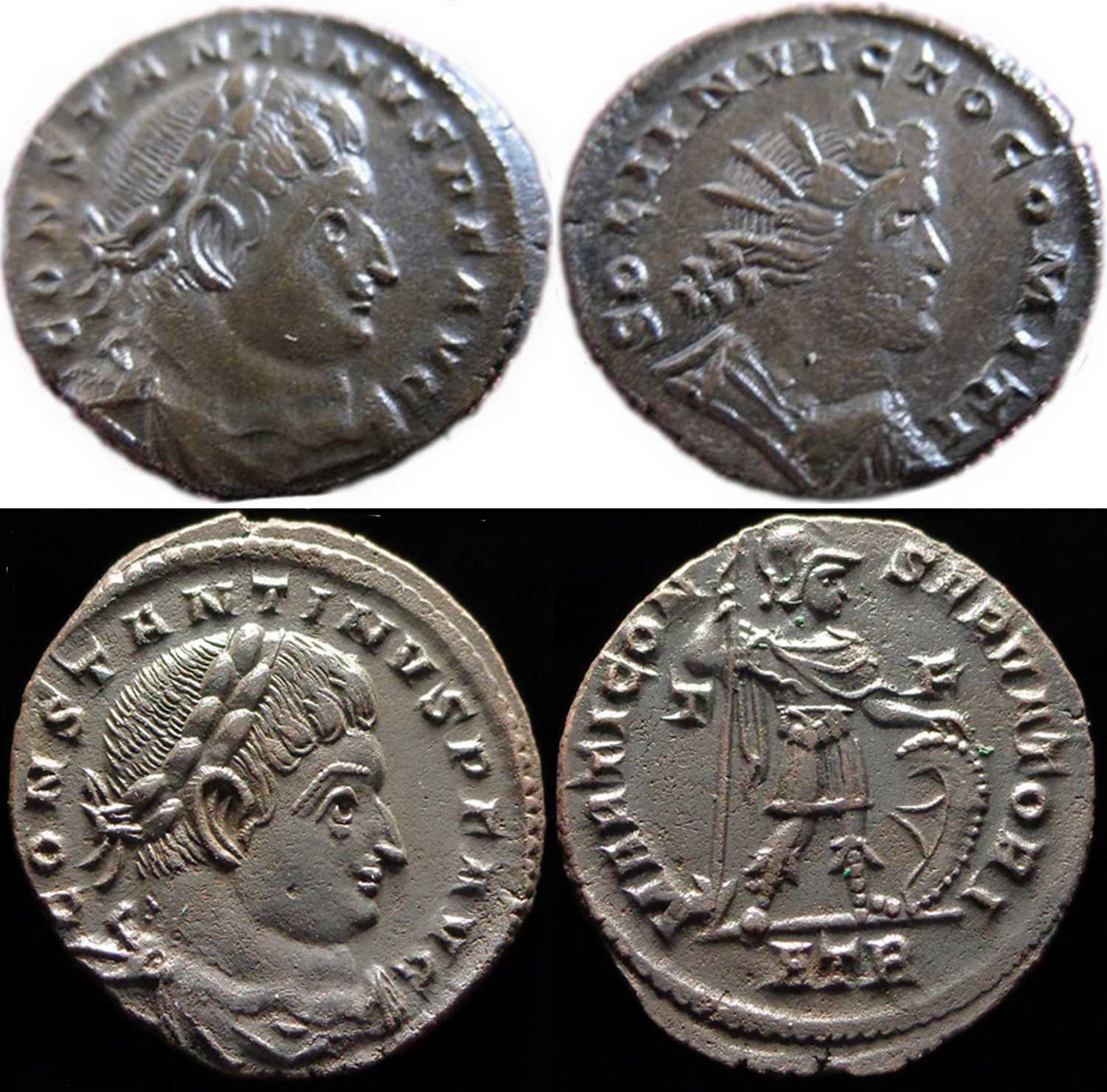
Note that the 1/96 emission was continued up to 316, which is proven by the die match discovered by Genio popvli romani. Compare obverses of coin from 1/96 emission with Sol [2.99 g; 19-20 mm] and of coin from T|F/ATR emission [2.90 g; 19 mm; TRIER 113].
See also: Lawrence H. Cope, "The sequence of issues in the long T/F series of Constantinian folles minted at Trier, A.D. 309-315", Schweizer Münzblätter 1969, no. 75, pp. 59-66.
Coin should be listed after TRIER 60.
See also:
TRIER [after 60], CONSTANTINE I, UNLISTED ISSUE [Bust of Sol]; obv. legend 1c, bust B3
TRIER [after 60], CONSTANTINE I, UNLISTED ISSUE [Bust of Sol]; obv. legend 1c, bust B4
TRIER [after 60], CONSTANTINE I, UNLISTED ISSUE [Bust of Sol]; obv. legend 1c, bust B5
TRIER [after 60], CONSTANTINE I, UNLISTED ISSUE [Bust of Sol]; obv. legend 1d, bust B3
TRIER [after 60], CONSTANTINE I, UNLISTED ISSUE [Bust of Sol]; obv. legend 1d, bust B5
|